
Englewood Organizers To Transform Old Leon’s Bar-B-Q Into $6.4 Million Community Destination
By Atavia Reed, Block Club Chicago | June 16th, 2026 (Click Here For Original Article)
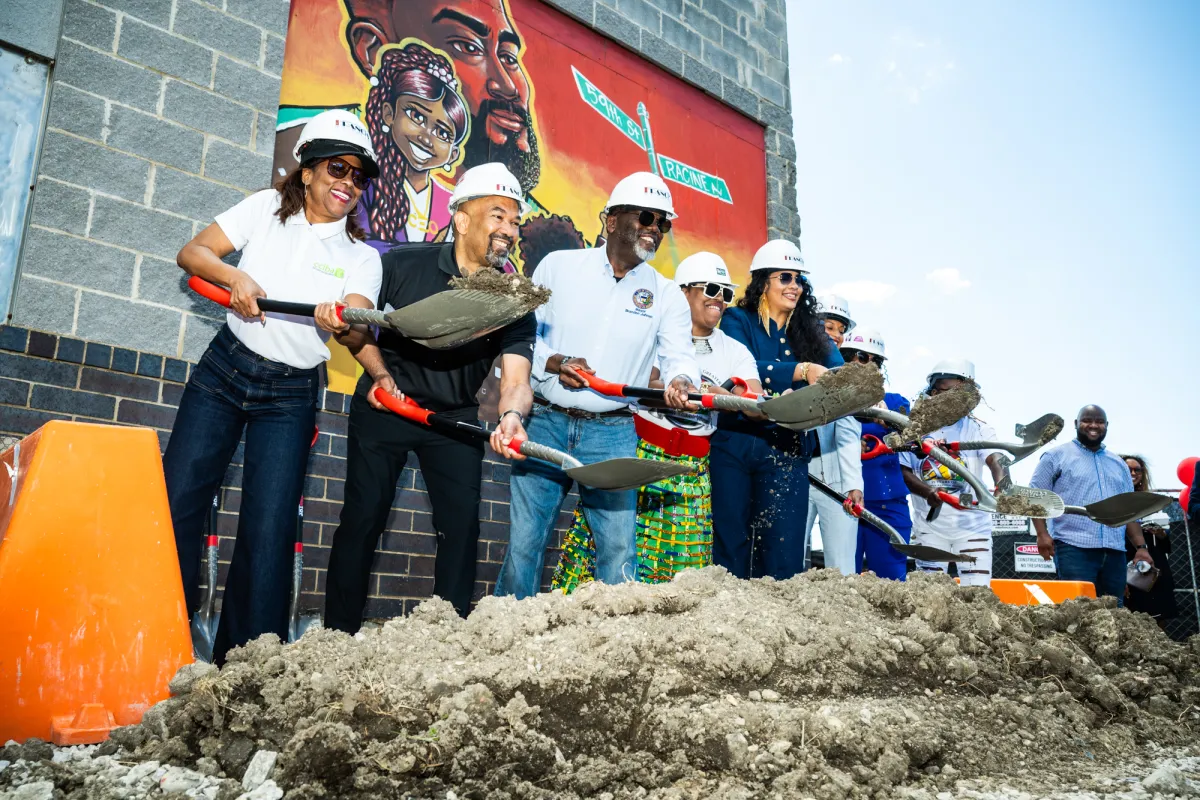
ENGLEWOOD — Dozens of neighbors, organizers and local leaders gathered Monday to celebrate the groundbreaking of The Re-Up at 59th and Racine — a $6.4 million investment set to transform a desolate corner.
Jazz maestro Ernest Dawkins and crew provided the soundtrack while neighbors danced and feasted at Another So Fresh, an event hosted by the Resident Association of Greater Englewood — known as R.A.G.E. — to kick off Juneteenth week and commemorate a construction milestone at the space.
 R.A.G.E. is converting the former Leon’s Bar-B-Q at 1158 W. 59th St. into The Re-Up at 59th and Racine, a mixed-used commercial development. The 14,390-square-foot, two-floor hub will be the new headquarters for R.A.G.E., and it will offer additional space for businesses and offices that want to “sink their teeth into the magic that’s happening here in Englewood,” Executive Director Asiaha Butler said.
The Re-Up at 59th and Racine “continues our mission of doing work for the community, by the community,” Butler said. “I’m excited by the progress that we’ve made so far, the investments that we have, and to share our story. I’m just in awe.”
The Re-Up will open in early 2027, Butler said. Local company Francis Construction Group is fabricating the space.
Spot 2, a second location of Spot Bistro — one of Englewood’s only sit-down restaurants — could also operate in the mixed-use development as Butler said the restaurant has expressed interest.
Butler announced in 2023 R.A.G.E.’s plan to revive the former Leon’s and create a dining destination at the corner of 59th and Racine. At the time, three restaurateurs submitted letters of interest for the space, but their plans changed as the project faced “unpreventable delays,” Butler previously said.
R.A.G.E. acquired the abandoned building that same year from the Cook County Land Bank Authority for $35,000. The Land Bank had owned the building since 2020 after property taxes for the Englewood building became delinquent in 2017, said Executive Director Jessica Caffrey.
After partnering with the Englewood organization to remodel a vacant home and award vacant lots to neighbors, the Land Bank was “proud” to unite again, Caffrey said.
R.A.G.E. “provides the vision, [and] we have the inventory,” Caffrey said.
Local projects developed at the corner of major street intersections — like the Re-Up — are “critical” because they help define a community, “including where it’s been and where it’s going,” said Ciere Boatright, commissioner of the city’s Department of Planning and Development.
Development for The Re-Up at 59th and Racine is supported by a $2.5 million grant from the city’s Neighborhood Opportunity Fund — a “Robin Hood” program where Downtown construction fees are diverted to neighborhood investment projects, Boatright said.
“Kudos to Aisha Butler and the R.A.G.E team for leveraging the fund, its remarkable vision, this amazing project and its unyielding commitment to Greater Englewood because The Re-Up is more than a building — it’s a mission that ultimately makes the city a better place to live, work and raise families,” Boatright said.
Monday’s groundbreaking ceremony was “a transformational moment” for Englewood, said Mayor Brandon Johnson. The Re-Up at 59th and Racine will “breathe new life” into the community, he said.
“This kind of development and revitalization doesn’t happen in a vacuum,” Johnson said. “It happens when communities come together, demand action and through new collaborations and bold partnerships. And it happens through a desire to build a city where everyone, no matter their ZIP code, can achieve their dreams and access these opportunities.”
When R.A.G.E. began its efforts in Englewood 15 years ago, members realized “we are our own solution,” Butler said. Members started their work on their blocks, buying and repurposing vacant lots into gardens and pocket parks.
R.A.G.E. kept “thinking bigger” and partnered with other local organizations to buy the former Woods Elementary at 6206 S. Racine Ave. The Regenerator, a $26.6 million affordable housing and community center development, will soon open at the long-vacant school.
When eyeing the former Leon’s building, R.A.G.E. saw “a canvas for development,” Butler said.
Whenever someone believes the organization is “too crazy, that we can’t do it … we see vision, we see an opportunity,” Butler said.
“A lot of seeds that R.A.G.E. planted, started, founded or created are still growing. Today, we’re planting something more.”

Reclaiming Chicago Initiative Adds 10 homes In Roseland
By Abby Miller, Chicago Sun-Times | May 1st, 2026 (Click Here For Original Article)
Neighbors and project partners gathered Friday on East 118th Street in Roseland to celebrate the newest homes built under the community-led campaign Reclaiming Chicago.
The Hope Center Foundation and Chicago Neighborhood Initiatives, partners in the campaign, held a ribbon-cutting for 10 homes in the Far South Side neighborhood. Four of the properties are under contract, and five potential buyers have been referred to lenders, according to the Hope Center.
 With Phase 2 in Roseland complete, 90 homes now have been built under Reclaiming Chicago. The campaign’s mission is to build 2,000 homes across the South and West sides to help combat decades of disinvestment.
“What makes this effort distinct is its alignment. It brings together residents, faith institutions, developers, nonprofits, lenders, government and policymakers … around a shared goal to produce housing at scale with intention — and at a price point that working families can realistically attain,” Shenita Muse, executive director of the Hope Center, said. “This is how we rebuild and strengthen neighborhoods, and this is how we ensure that revitalization includes the very families who have remained committed to these communities.”
Reclaiming Chicago, led by the civic coalition United Power for Action and Justice, has raised $52 million to build homes and offer subsidies to buyers. Buyers of the Roseland homes are receiving about $50,000 in down payment assistance, according to Jessica Caffrey, executive director of the Cook County Land Bank Authority.
Many of the three-bedroom homes are on the same block where 11 properties from the first phase of development were completed in late 2024.
Part of Reclaiming Chicago’s goal is to draw new investment and build community, and it does that by focusing on areas with high vacancy rates. The effort seems to be working.
David Doig, president of Chicago Neighborhood Initiatives, said neighborhood reinvestment is already happening after the first phase of Roseland homes were completed.
“We have seen such a transformation of this particular block and the surrounding blocks,” Doig said. “Existing owners are now fixing up their properties, making investments in their own properties. We’re seeing former vacant buildings that are being rehabbed. … When people see hope, we see investment follow.”
The 10 lots in Phase 2 were provided by the land bank. Caffrey said it has acquired more than 40 lots for the Hope Center to build Reclaiming Chicago homes, which will help families build equity and generational wealth.
Keshanna Pope said homeownership felt out of reach, like it does for many other millennials and Gen Z, who can’t afford a home due to skyrocketing costs. But Pope was able to purchase one of the Roseland properties, saying Reclaiming Chicago’s strategy — which includes services and classes for potential buyers — helped her achieve that dream and feel connected to her community.
“I didn’t just gain a home because I became a part of the community,” she said.
Hope Center plans to break ground in Roseland on 20 homes next fall, followed by another 50. That will bring Reclaiming Chicago’s total development in Roseland to 91 homes, according to Muse.
Reclaiming Chicago has about 200 homes in different development stages. Besides Roseland, it’s targeting three other neighborhoods: Back of the Yards, Chicago Lawn and North Lawndale. It expanded to Chicago Lawn last year thanks to a $10 million grant from the Pritzker Traubert Foundation.
“We’re moving. We have a vision,” Jeff Bartow, executive director of Southwest Organizing Project Illinois, said. “We recognize, though, in order to succeed, we need to move at pace and at scale. We need to take large sites, identify them, take them, build on them. We need to continue to do infill construction.”

New Housing Near Garfield Park In The Home Stretch
By Abby Miller, Chicago Sun-Times | May 1st, 2026 (Click Here For Original Article)
Will Johnson has lived near Garfield Park for about 40 years. So when he saw developers building new homes on his block, he was hesitant to embrace the change.
But now that the homes are materializing, Johnson — who says he’s seen the neighborhood rise and fall over the years — is feeling more optimistic. So are his neighbors.
“When people are set in their ways, it’s hard to do new stuff,” he said. “But now that it’s kicking in gear, people are like, ‘Oh, wow, [it doesn’t] look bad.’”
Johnson has noticed less crime and blight on his block as developer Luis Castro builds two- and three-flats in the 500 block of North Lawndale Avenue. He and other neighbors, in addition to Castro and local leaders, joined the Cook County Land Bank Authority Tuesday to cut the ribbon on Castro’s fourth home on the block. It’s also the 2,500th completed home acquired through the land bank.
Cook County Board President Toni Preckwinkle said the land bank’s latest milestone is important. The authority was established to address some of Cook County’s most pressing issues, including vacancy, tax delinquency and disinvestment.
“When we unlock land, we unlock the possibility for homeowners, for developers, for families and for entire neighborhoods,” she said.
The two-flat replaces a vacant lot and features a garden-level two-bedroom unit and a three-bedroom duplex on the first and second floors, according to the land bank. It’s the first new two-flat on the block and is unsold, though sales for nearby three-flats have been “on fire right now,” Castro said.
“I think we’re back at a point where we need the multiunits in order to establish these first homeownerships so that they’re not jumping into such a sticker shock with the mortgage payments,” Castro, who owns USA Roofing Supply, said. “It’s a perfect buy for a first-time homebuyer.”
Castro has been building homes since 2008. He said buying from the land bank has helped increase the number of homes he builds annually and reduce costs, which helps amid recent spikes in the cost of construction materials and labor. The land bank acquires tax delinquent and abandoned properties and wipes their slates of taxes and liens before selling them to developers — often at a cheaper price.
Nearly all of Castro’s homes are built on land from the authority, he said. He said he thinks the process spurs more development in the private market.
“What we’re doing is we’re creating the urgency of seeing a block being built,” Castro said.
He has two more buildings under construction, for a total of six properties on North Lawndale Avenue. Only one is a two-flat, while the other properties are three-flats. Once complete, Castro will have added a total of 17 units. Eleven units are finished. Past units have sold for $719,000 to $749,000, with the land bank providing $20,000 in financial assistance to three of the buyers.
The land bank said the six buildings are expected to create up to $3.5 million in community wealth on the block. It calculates community wealth by subtracting the value of vacant land from the purchase price of the new home.
Since its founding in 2013, the land bank has created $300 million in community wealth. But it hasn’t been without troubles, including a 2020 audit that found land bank officials hadn’t documented what they’ve done to avoid conflicts of interest on land deals involving the county agency. In 2023, a former asset manager for the land bank was sentenced to a year in prison for using straw buyers to buy and resell properties from the land bank on his behalf.
The land bank’s executive director, Jessica Caffrey, said Castro is the perfect example of the authority working as it’s supposed to: helping developers scale up their business to create new community investment.
Caffrey said the land bank is strengthening its operations, including collaboration with the city of Chicago to acquire more lots and continue its mission. To date, the land bank has generated more than $1.8 billion in economic impact.
Johnson’s wish is that more new homes translates to more resources for the community.
“Hopefully, it makes the community better,” he said. “Now we just got to hope that whoever’s got their foot on the gas, keeps it on the gas.”
South Side flower shop owner named CNN’s Hero of the Year
By Mohammad Samra, Chicago Sun-Times | December 8th, 2025 (Click Here For Original Article)
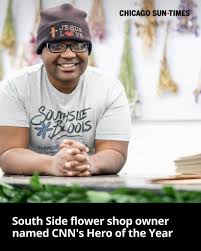
 Quilen Blackwell, owner of a Chicago nonprofit that employs at-risk youth to turn vacant lots into flower farms, has won CNN’s Hero of the Year Award. Blackwell is CEO of Chicago Eco House, which grows flowers on South and West side lots, and Southside Blooms, an Englewood flower shop at 6250 S. Morgan St. His organization has been employing at-risk youth, ages 16 to 24, since 2014 at gardens in Englewood, Woodlawn, Washington Park and West Garfield Park.
The award comes with a $100,000 prize that Blackwell said he will use to convert
more empty lots into flower farms. “This is a big win for the ‘hood — and a big win for Chicago,” Blackwell, 41, told the Chicago Sun-Times Monday. Blackwell said business in booming, and he needs to grow more flowers to meet demand he expects in 2026. He said he wants to buy more vacant lots from the Cook County Land Bank to expand flower operations. This year, his group converted three lots on the West Side, he said.
Blackwell created Chicago Eco House to help curb violence in the city. The flower shop Southside Blooms opened in 2020 at the nonprofit’s headquarters at 6439 S. Peoria St. The shop moved the following year to its location on Morgan Street. Blackwell has been profiled several times in the Sun-Times.
In 2021, Blackwell told the paper that providing work to youth is one way to curb violence. “It’s a national problem that we’re talking about, and we feel like we have … at least an economic solution that can help take a big chunk out of that problem,” he told the Sun-Times then.
His organization provides 10-week trainings for some people in the Cook County Juvenile Probation program, he said then. Some of those trainees are hired at $15 an hour as floral assistants, greeting card assistants or farm assistants, he said.
“A lot of the youth that we work with are kids who are coming off the streets,” Blackwell said then.
In 2022, “The Ellen Show” gifted $10,000 to Southside Blooms, which was featured on the show.
Eco House had 10 acres of flower farms across the city in 2023. The group even had beehives to make beeswax for natural candles. Blackwell grew up on Madison, Wisconsin, volunteered in the U.S. Peace Corps in Thailand, then enrolled in 2011 in a school in west suburban Chicago to study ministry. He later tutored at an Englewood high school, according to his online biography.
Blackwell said he was “absolutely stunned” when he learned he won CNN’s annual award.
“We had a lot of stiff competition,” he said Monday. Blackwell said he is happy the award is focusing attention on a positive effort in the city. “There’s a lot of good things going on in the city that sometimes get drowned out,” he said. CNN said the award aims to honor “everyday people who are making extraordinary contributions to help improve the lives of others.”
Reclaiming Chicago Project Breaks Ground On New Homes
By Lourdes Duarte, WGN Chicago | August 1st, 2025 (Click Here For Original Article and To See the Video Broadcast)
 CHICAGO — A step was taken Friday to address the lack of affordable housing in the Chicago area.
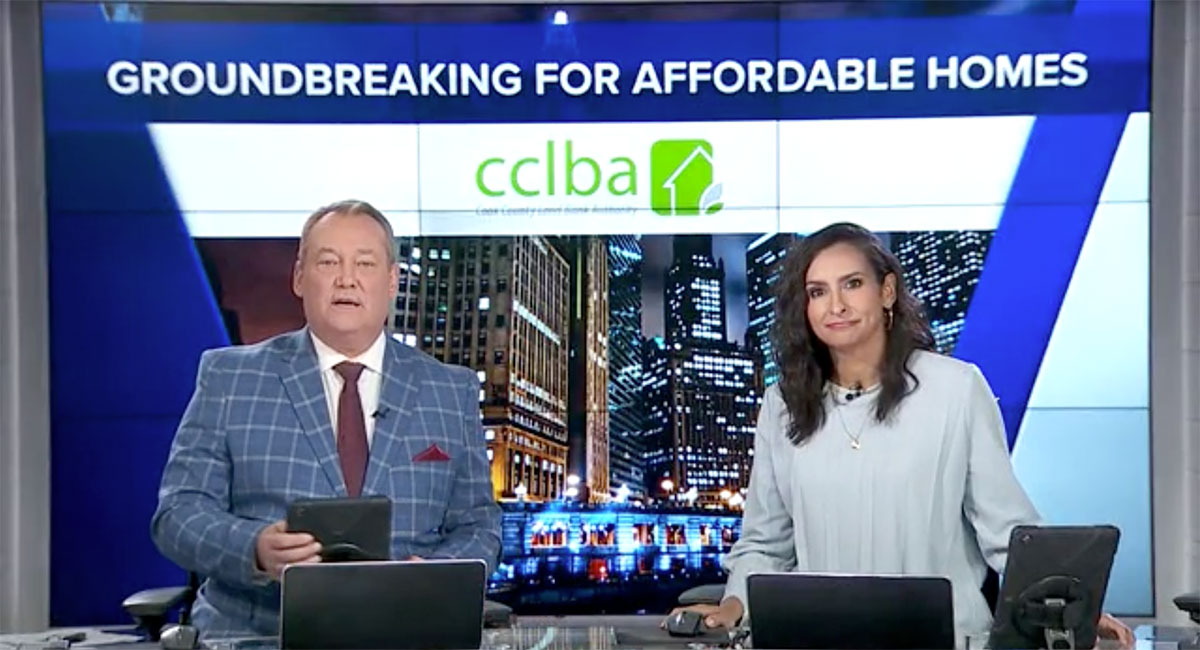
Crews broke ground on the Reclaiming Chicago project that will deliver 10 new homes in the next six months.
Cook County Board President Toni Preckwinkle touted the initiative led by the Hope Center Foundation and Cook County Land Bank Authority. In the majority of the cases, the land bank provides the vacant lots. Crews use that land to build 1,600-square foot homes worth an estimated $230,000 dollars in the Roseland neighborhood.
So far, Reclaiming Chicago has completed 59 homes. Another 71 homes make up the next phase to begin construction not just in Roseland but Back of the Yards and North Lawndale..
Ground Broken On More South Side Lots To Be Turned Into Homes For Reclaiming Chicago Initiative
By Violet Miller, Chicago Sun-Times | August 1st, 2025 (Click Here For Original Article)
The community-led campaign has drawn $40 million in support from public and private lenders with the goal of building 2,000 homes on the South and West sides.
James Williams Jr. and his wife got married last year, and within 12 months had the keys to their first home — something he never imagined was possible.
“My mother and father never owned a home, so I had no reference,” Williams said. “It was something I could never dream of.”
The effort was part of the community-led Reclaiming Chicago campaign, which has drawn $40 million from the city of Chicago, the state and private lenders with the goal of building 2,000 homes on the South and West sides. It’s led by the civic coalition United Power for Action and Justice.
More than 80 homes were finished last year as part of the first phase, and 11 have been finished since December.
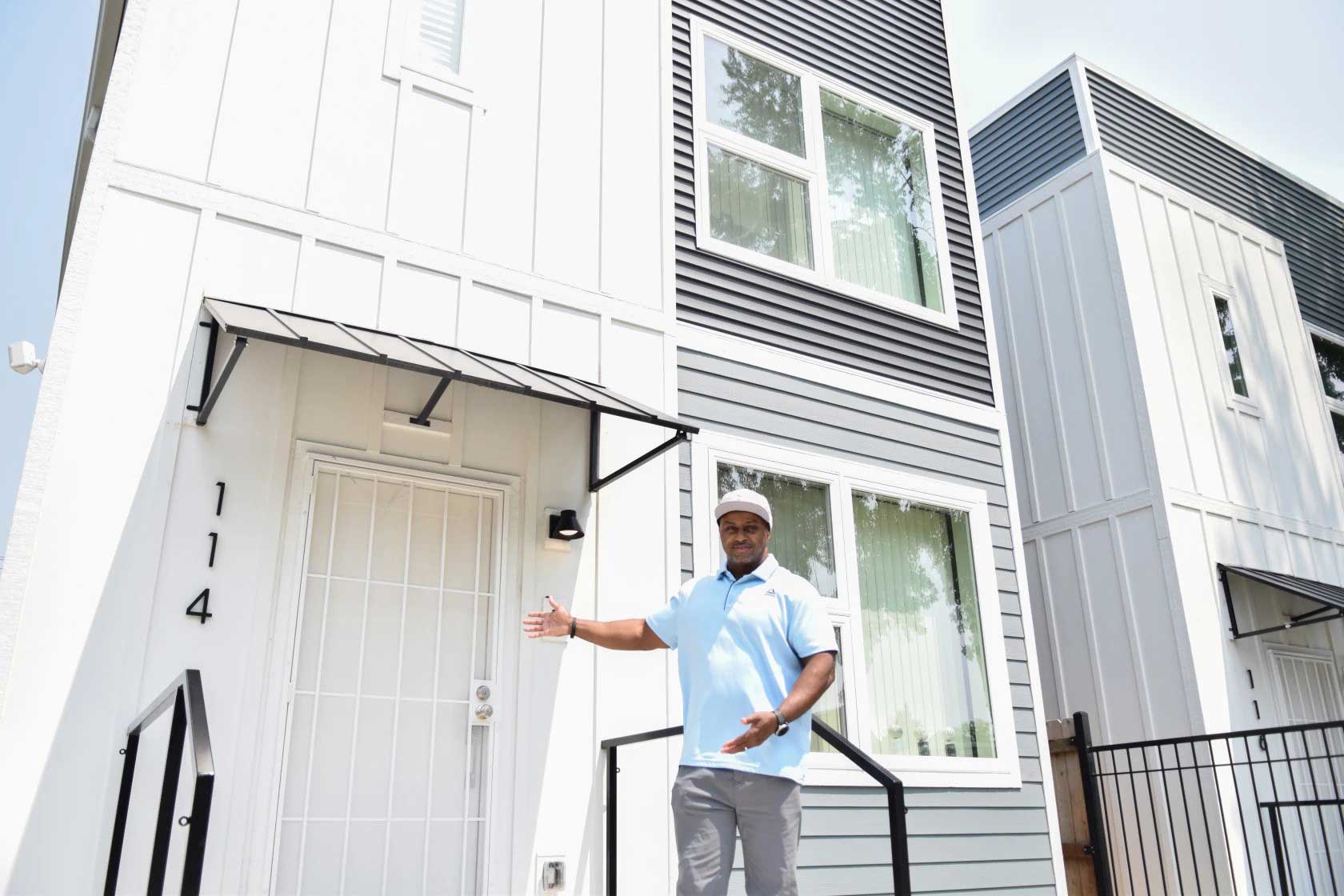
The organizations involved broke ground Friday on 10 more lots in Roseland. That’s ahead of another 50 in a six-block radius that will be split between the spring and fall of next year. Several of the Cook County Land Bank lots were on the same block where homes were finished late last year.
The group has focused on areas with empty lots, which tend to be areas where there hasn’t been much new housing built in decades, according to Shenita Muse, executive director of the Hope Center Foundation, a coalition member.
“It is putting a belief system into them that homeownership, generational wealth and equity building are attainable to them,” Muse told the Sun-Times.
The homes cost around $230,000, though they come with a $50,000 down payment assistance grant, according to Muse. The group’s waiting list sits at 400 people, who are going through financial education that helps prep to be first-time homeowners.
Two issues still face the group: securing more funding and maintaining taxes for the new homeowners and those in homes around them.
Escrow accounts were set up for the new homeowners’ first-year tax bills, and Muse said she’s hopeful an ongoing dialogue with Cook County Assessor Fritz Kaegi’s office will help keep the neighborhood’s current residents from seeing drastic property tax increases.
“We are not developers; we are community builders,” Muse said. “At the end of the day that’s what we’re looking for.”
The effort goes beyond just the homes. Williams was connected to the Hope Center Foundation through his church — specifically former state senator and current pastor James Meeks, one of the Hope Center’s founders — but had lived in the area prior.
Williams has been trying to get the city to help repair the neighborhood’s alleys after getting it to remove some graffiti. He said he hopes to see the program fill the rest of the empty lots on his block.
“You can see the neighborhood has been down for a long time,” he said. “But if they keep adding, it brings it up. I just pray and hope they don’t forget about this neighborhood. I know they started it. They need to complete it.”